
Venus rules two astrological signs, Taurus and Libra.
Venus attracts to herself through the power of love. The glyph for Venus represents the circle of the spirit on the cross of the soul.
The glyph symbolises overcoming materialistic living through love.
The Glyph can be traced back to the classical Greek era.
The glyph is derived from the hand mirror or necklace.
Since the 1750’s the symbol has been used to denote female sex in biology.
Venus is situated between Mercury and Earth making her the second planet from the Sun.
It takes 224.701 Earth days for Venus to complete an orbit around the Sun. It takes Venus 243 Earth days to complete a full rotation on her axis. Venus rotates in a retrograde direction, meaning that she spins clockwise on her axis, which is opposite to the other planets in our solar system. There is a current theory that she did spin in the same direct as Earth, however she flipped upside down at one point and now appears to be spinning backwards.
Venus is similar is mass and size to earth and is often described as Earth's twin.
She has no satellites.
She has a thick cloud layer of sulphuric acid that engulfs her entire surface.
The surface pressure on Venus is 9.3 megapascals. For comparison Earth's surface pressure at sea level is 0.01megapascals, making Venus's surface pressure about 92 times that of earth.
The average surface temperature is 464 degrees C - 867 degrees C.

Venus is the goddess of love & beauty. She represents our values. Venus is interested in relating & relationships. It is through Venus that we find alignment with the aspect of our personality that draws life towards us. Creative & pleasure seeking, she is the urge to overcome materialistic living through love. Love makes us conscious of others & evokes in us a deep appreciation of beauty, whether that be the arts, nature, or the pure joy of being at ease in the social world & relationships. Through Venus we come into relationship with the language, movement & embodiment of our self-worth. It is through Venus's relationship to & appreciation of the beauty of the natural world, that we come to the understanding that we are not on the earth, but rather that the bodies that host our souls are of the earth.
VENUS MOOD BOARD














Phases of Venus
In 1610 the first full planetary phases of Venus were observed by Galileo Galilei. With the use of a telescope Galileo was able to prove that Venus orbited the Sun, not the Earth, as was the established belief.
The phases of Venus are like the Moons phases, which are the variations of light seen on its surface.

The Five Petals of Venus
The Venus Phases are of course viewed from earths perspective. The time it takes Venus to return to the same position relative to the Sun as seen from Earth is 584 days. This is known as Venus 's Synodic cycle.
This differs from Venus's Sidereal cycle, which it the time it takes for Venus to make a full orbit around the Sun.
During Venus's 584-day Synodic cycle, she retrogrades once for about 40 to 43 days.
Over 8 Earth years (approximately 2922 days) Venus completes 5 Synodic cycles, and therefore retrogrades 5 times.
When this 8-year cycle is mapped out, it createw what is referred to as the 5 Petals of Venus.

Values
Values are the core principles and personal beliefs that we live by, they lie at the core of our identity. Values are transmitted through relationship and mediated by culture. They are imbedded through contact with our socialising agents. Our primary socialising agents are our families and close community members during early childhood. Our secondary socialising agents are the people and institutions we encounter through adolescence and early adulthood who reinforce the values we most identify with.
Values are the domain of Venus, and it is through our values that we relate to others and the world around us. They are the medium through which relationship becomes possible.
Morals
Morals are social norms that support social order. They reflect the ethos and behavioural expectations of a given society. Morals are not static. As they emerge within social structures, they are impacted by and adapt to shifting social conditions. Yet some morals remain steadfast and are foundational in systems and institutions.
They represent shared beliefs, and it is through the understanding of our collective meaning-making that we navigate the maze of society. They are a social compass, orienting an individual within the social systems they inhabit. The morals we believe are our own are heavily shaped by the institutional transmission of social values, and this social process heavily impacts our psychology, reasoning, and personal reflection on our own morality.
In Taurus our values are embodied, and it is in Taurus where we are likely to meet institutional values that are enduring and appear fixed. This is not to say that morals are the domain of Taurus alone. However, it is in Taurus where we clearly see a more static morality, a clear continuity and preservation of sacred tradition, as in Taurus values become stabilised and are carried forward through time. In the Hierophant, the Tarot card associated with Taurus, we encounter a spiritual authority, a gatekeeper to divinity, a teacher of the moral codes embedded within traditional systems. These fixed values are the bedrock of many traditional systems, such as religions, structures of monarchy, and family systems. In Taurus, we tend to see the embodiment of enduring social norms.
In Taurus we see a process where desire ignites and reinforces values, values become behaviour, behaviour becomes tradition, and tradition becomes insitution.
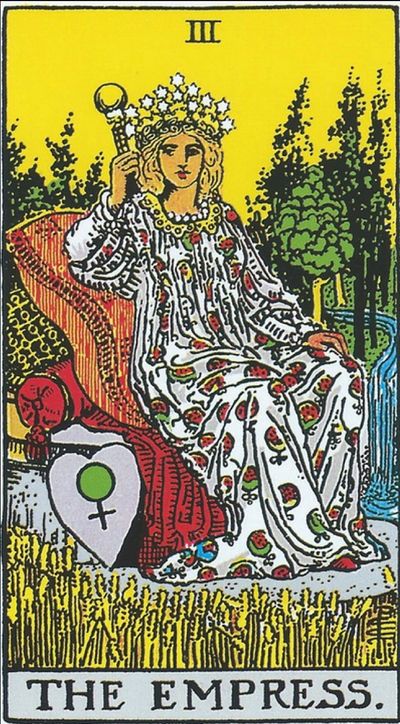
The Tarot card associated with Venus is the Empress.
The Empress is the archetypal mother. She represents love, embodiment, and nurturing. She is comfortable in her body and is engaged fully with the physical world. She is connected to her physical senses and has a strong connection to her emotional life. The Empress represents alignment with our creativity. She invites us to nurture our creativity, and our creative visions so that they may be realised. The Empress takes care of herself and honours the needs of her physical form.
She radiates, sensuality, sexuality, and fertility. Her nature is abundance. The Empress teaches that we have all that we need. That we are enough. The Empress is love. She loves herself, others, and the world around her. She gives of herself, and in doing so draws others towards her, representing an aspect of the psyche that is seductive and charming. Arthur Edward Waite, the author of the Rider-Waite tarot, describes the Empress as representing, fruitfulness, action, length of days, the unknown, clandestine, difficulty, doubt, and ignorance.
On the card we see her surrounded by nature. In the forefront of the card we see corn or grain, representing the abundant produce of the natural world. She has a shield by her side adorned with a symbol of Venus, symbolising her connection to her values and her sensuality. She wears a crown of twelves stars, which correlates to the twelve signs of the zodiac, and around her neck she wears a string of pearls, which are said to represent the planets in our solar system. This symbolises her attunement to universal patterns and cycles. A laurel wreath adorns her head, symbolising peace, success, and victory. Her dress is covered in a pomegranate print, symbolising fertility, death, and rebirth. She holds a sceptre, symbolising power, security, and authority. The river in the background speaks to her connection to her emotions and the movement of the stream that turns into a waterfall represents that her emotions are in motion, and she is in alignment with the flow of her emotional life.
The Empress is pleasure seeking and somatically orientated and must be mindful of the traps and pitfalls of a life that is focused on gratification. She teaches that it is through compassion and living a life aligned with our values that we may experience the richness of who we are.