
The glyph symbolises a bull's head and horns. The bull's horns resemble the crescent moon, and represent growth and the generation of new life.
Taurus resonates with "I Have".
Taurus is sensation orientated.
Taurus is connected to the body and the five physical senses.
Taurus's journey is one of embodiment.
Being aligned with their own personal values is important to Taurus, and is a significant part of Taurus's journey.
The basic nature is the builder, the accumulator.
The ruling planet is Venus.
Taurus rules the Second House.
The basic quality of Taurus is practically determined.
The energy of Taurus is comforting, calm, present and stable.
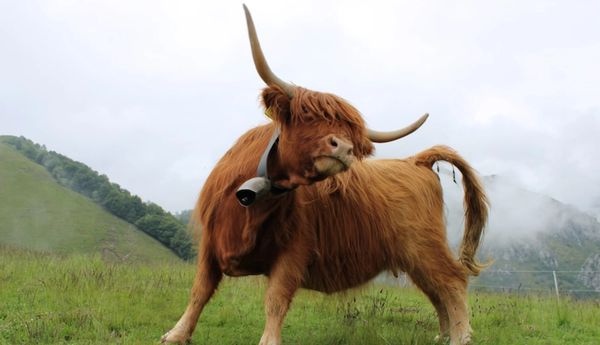
The symbol for Taurus is the Bull.
The Bull is steady, grounded, patient, slow to move but has an immense force when in motion.
The Bull is a presence that is rooted and patient
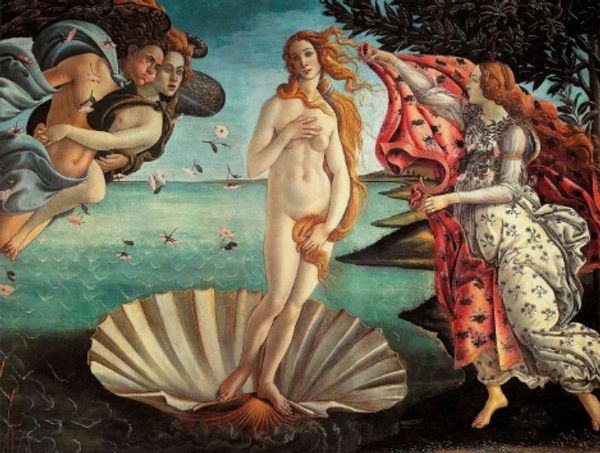
Taurus's Ruling Planet is Venus
Venus is the goddess of love & beauty. She represents our values. Venus is interested in relating & relationships. It is through Venus that we find alignment with the aspect of our personality that draws life towards us. Creative & pleasure seeking, she is the urge to overcome materialistic living through love. Love makes us conscious of others & evokes in us a deep appreciation of beauty, whether that be the arts, nature, or the pure joy of being at ease in the social world & relationships. Through Venus we come into relationship with the language, movement & embodiment of our self-worth. It is through Venus's relationship to & appreciation of the beauty of the natural world, that we come to the understanding that we are not on the earth, but rather that the bodies that host our souls are of the earth.
For more information on Venus click the button below:

Emerald
The birth stone for Taurus is emerald. It is known for its spiritual properties of love, compassion and emotional healing and is referred to as the stone of successful love.
Emerald is a crystal of the heart. It is a stone of aspiration and inspiration, that allows the heart to feel hope after misfortune, clearing beliefs around victimisation and loss of autonomy.
Emerald offers a vibration that can assist with rebalancing the heart chakra, promoting self-love and love of others.
Taurus Mood Board






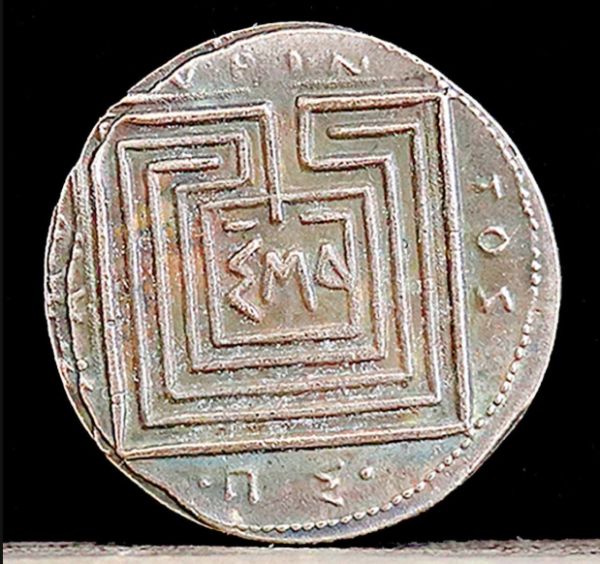
Theseus and the Minotaur
Theseus, is a hero, known for his slaying of the Minotaur, a monster with the head of a bull and body of a man. The Minotaur was the son of the Queen of Crete, and a magical bull that Poseidon had gifted to the King of Crete, King Minos. Poseidon had commanded that King Minos was to sacrifice the bull in his honour, but Minos disobeyed. As punishment, Poseidon cursed Minos’s queen with overwhelming lust so that she would mate with the bull. In doing so she fell pregnant and gave birth to the Minotaur. The Minotaur proved monstrous and fed upon human flesh. King Minos of Crete commanded the master craftsman Daedalus to design a labyrinth beneath the palace of Knossos of Crete to house and imprison the Minotaur.
There had been conflict between the kingdoms of Crete and Athens. Crete won the conflict. To spare the people of Athens further suffering, King Aegeus of Athens offered King Minos of Crete any tribute that would bring peace. King Minos commanded that Athens would give up seven of its sons and seven of its maidens every seven years as sacrifice to the Minotaur.
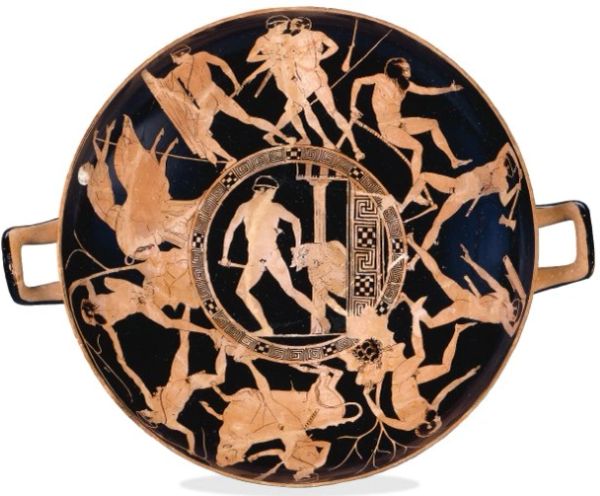
Theseus’ mother was Aethra of Troezen. On the night she fell pregnant with Theseus, she had sex with both Aegeus, the King of Athens, and Poseidon, the god of the sea.
King Aegeus left for Athens and told Aethra to keep his identity as the boy’s father a secret. He hid a pair of sandals and a sword beneath a large stone, telling Aethra that when Theseus came of age, if he were strong enough to roll back the stone, he should claim the items and journey to Athens, where he would be recognised as the successor to the throne of Athens. As the grandson of the King of Aegeus, Theseus still had a privileged upbringing.
When Theseus came of age, he rolled back the stone, claimed the sandals and sword of his father, and journeyed to Athens. Along the way he faced six monsters, the six labours of Theseus, which established him as a hero. Once in Athens Theseus was recognized and accepted by this father as his son and a prince of Athens.
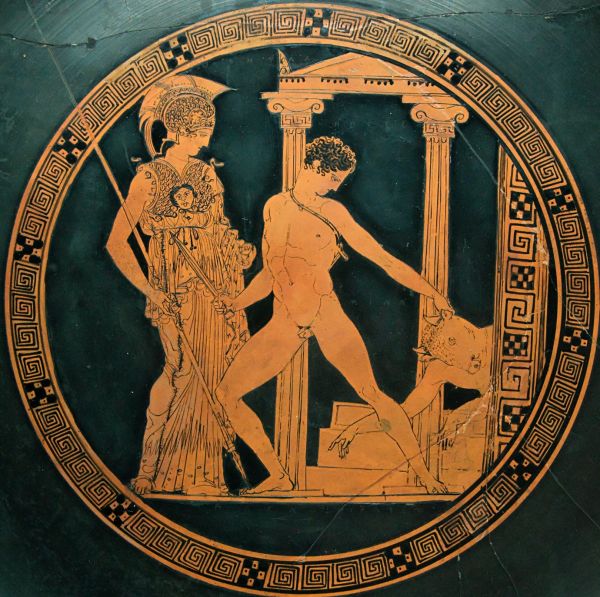
As a prince of Athens Theseus volunteered as tribute to be sacrificed to the Minotaur and sailed to Crete on a ship with black sails. Theseus vowed to kill the Minotaur, end the sacrific of Athenian youth to Crete, and promised that upon his return he would change the sails to white to signal his victory.
Upon arriving in Crete, Ariadne, the daughter of King Minos, fell in love with Theseus at first sight and vowed to help him. She gave him a sword and a ball of thread so that when Theseus entered the labyrinth, he could kill the Minotaur and then follow the thread back out of the maze, in exchange for Theseus marrying her.
Theseus accepted, killed the Minotaur, emerged from the labyrinth, freed Athens from its obligation to sacrifice its sons and daughters, and sailed from Crete. Ariadne departed with him for Athens but was later abandoned on the island of Naxos. Theseus sailed onward but forgot to change the sails from black to white. Seeing the black sails approaching Athens, King Aegeus believed his son dead, threw himself into the sea, and died. Theseus then ascended to the throne of Athens.
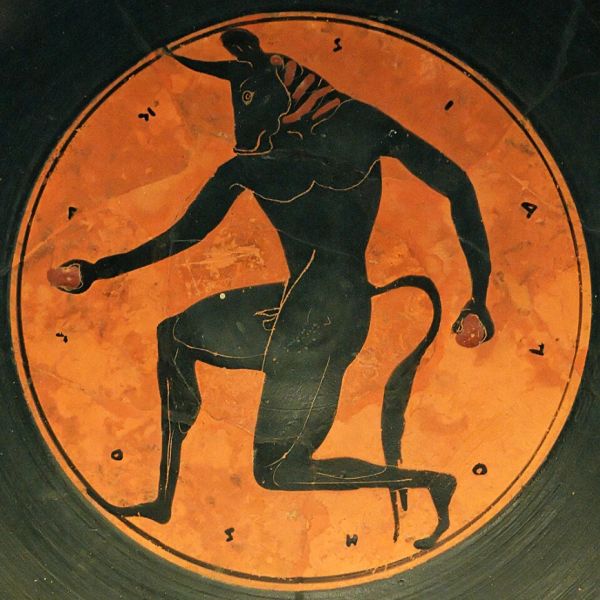
Psychologically, the myth of Theseus and the Minotaur represents an aspect of Taurus that can only be intergrated by going beyond and beneath the surface to confront something within the self that appears monstrous.
The Minotaur represents the untamed desire of Taurus, the excessively lustful and hedonistic aspect of the psyche that is often hidden from society. It is the part that seeks gratification through excess, the part that becomes over sexed, abuses drugs and alcohol, overspends on credit cards, and indulges compulsively in desires that have not been integrated into a value system that supports stability. It is the hidden aspect of the psyche, the deep burning desire that is tucked away beneath the surface, concealed from others and often from oneself.
The journey through the labyrinth reflects the necessity of descending into the hidden chambers of desire in order to confront, understand and integrate instinctual forces that are longing to create stability, but are lost in a maze of self-gratification and self-loathing.

There is a direct link between the myth of Theseus and the Minotaur, and the discovery of the city of Knossos in Crete. The discovery of this ancient city changed modern man’s understanding of the history of Europe. Prior to the discovery of the city of Knossos in the early 1900s, it was believed that modern European civilisation’s origin was Classical Greece, which dated approximately 500 BC. However, the excavation of Knossos unearthed a palace that dated back to approximately 2000 BC to 1400 BC, over 1000 years before Classical Greece. The civilisation at Knossos belonged to the Bronze Age and predated classical Greek history. This “prehistoric” civilisation of the Minoans was shown to have possessed writing systems, palaces, administration, trade networks, art, and religion.
Arthur Evans was the British archaeologist who discovered Knossos. Evans was born in 1851, the son of John Evans, a wealthy and distinguished geologist famed for his discoveries relating to Stone Age Britain. Evans, who lived in his father’s shadow, was determined to make a name for himself.
As a child, young Evans immersed himself in Greek mythology. His favourite hero was Theseus, a hero who slew the mythical Minotaur. In his 30s, Evans became keeper of the Ashmolean Museum at the University of Oxford. He was inspired by Heinrich Schliemann, a German archaeologist who in the 1870s excavated a site now widely accepted as ancient Troy. This led to the understanding that some myths were historically meaningful and preserved memories of real ancient civilisations. It is worth noting, modern archaeologists have determined that Troy was not one city, but many cities built on top of each other over thousands of years. Evans’ fascination with myth and the potential that the myth of the labyrinth of the Minotaur was based on fact and not purely legend led him on an archaeological journey of discovery.
Evans was not interested in treasure but language. Through his work in Oxford, he came into contact with what is known as seal stones. Seal stones are small carved objects, usually made of stone, used to create an impression in clay. Evans discovered that the seal stones had several purposes such as administrative control, identity, much like a signature, and religious or symbolic meaning. Evans believed that the images on the seal stones were part of a language, and that written text may have existed in Europe prior to Greek culture.
Evans suspected that the myth of Theseus and the Minotaur preserved a memory of a Bronze Age culture in Crete. One hill, Kephala Hill near modern Heraklion, had seal and inscription impressions similar to the seal stones he had been working with. This led Evans to the discovery of a major complex now known as the palace of Knossos. When Evans excavated Knossos, he believed he may be uncovering the historical background to the myth of the Minotaur. The palace complex was enormous and looked labyrinth-like. Images of bulls were everywhere, and he believed he found the throne of King Minos.
The seal stones, and Evans’ relationship to the myth of Theseus and the Minotaur, led Evans from a museum in Oxford to the excavation of a Bronze Age culture of elaborate architecture, frescoes, and numerous clay tablets that were evidence of old writing systems that dated back at least 1000 years before Classical Greece.
Evans’ story is rich in Taurean symbolism. His fascination with the myth of Theseus and the Minotaur seems to have had a deep psychological impact on him. At the centre of the myth stands a monster that is half man and half bull. The glyph for Taurus resembles a bull’s head. His determination to prove that the myth of the Minotaur could be held in his hand, speaks to the Taurean need to physically possess objects and give ideas material form. He was motivated to make a name for himself in a way that would be enduring, and did so through digging in the earth for what had been forgotten, all of which are associated with Taurus. His achievement unearthed cultural wealth and changed modern man’s understanding of European history.
TAURean ARCHETYPES
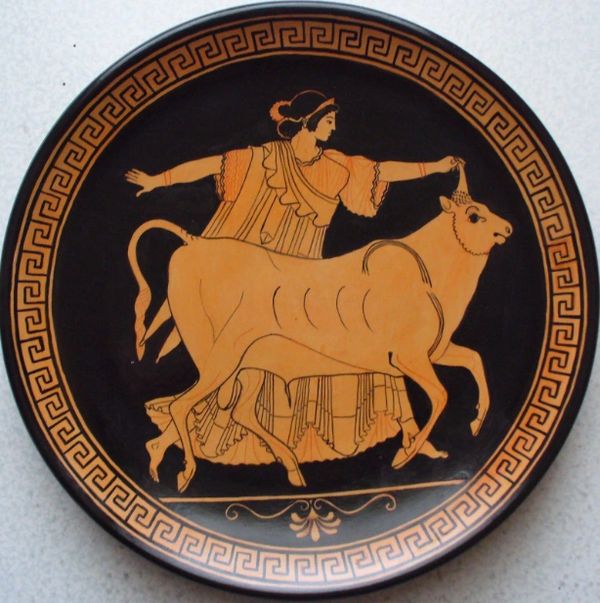
Europa
Europa, a mortal Princess of Tyre, a region now located in Lebanon, was one of the most famous of all of the lovers of Zeus. She was the daughter of King Agenor, which meant that she was in fact a great-great-granddaughter of Zeus.
Europa was a beautiful maiden who caught the eye of Zeus. Zeus transformed himself into a white bull. He approached Europa and her attendants on the shoreline of Tyre where Europa was gathering flowers. As a bull, Zeus lay at Europa’s feet. Feeling taken by the bull, Europa climbed on his back. Zeus waded into the ocean, and before Europa could jump off, Zeus had swum far offshore and headed across the Mediterranean Sea to the coast of Crete. Once on the shore of Crete, Zeus transformed into human form and he and Europa became lovers, making Europa the first Queen of Crete.
Europa and Zeus had three sons, Minos, Rhadamanthys, and Sarpedon, all of which would become legendary rulers and founders of powerful royal lineages. Zeus gave Europa four gifts: the Necklace of Harmonia, Talos, a gigantic man made of bronze that protected Crete, Laelaps, the hunting dog that always caught his prey, and a magic javelin that always hit its target.
Zeus recreated the image of the white bull in the stars, which became the constellation of Taurus.
In Europa’s story, we see Taurus’s connection to beauty, abundance, fertility, extravagance, skilled craftsmanship, and royal lineages. The extravagant gifts Zeus gives Europa reflect Taurus’s association with artisanship, luxury, and material richness.

Moon Goddesses
Taurus has a strong affinity with the Moon. The glyph symbolises a bull’s head and horns. The bull’s horns resemble the crescent Moon and represent growth and the generation of new life. The Moon is exalted in Taurus, and Taurus and the Moon share the qualities of nurturing and sustaining. The Moon represents our needs, our emotional life, instinct, memory, mode of nuturing and cyclical experience. The Moon has a monthly cycle with distinct phases. Taurus is connected to the seasons of the year. Both speak to the cyclic nature of our existence, that there is a time to reap and a time to sow. Astrologically, the moon governs internal cycles and Taurus governs cycles materially. The honouring of these cycles of life support growth, fertility, abundance, and sustainability.
Through connection to the cycles and rhythms of the natural world we come into a deeper relationship with ourselves, and our emotional life. Emotions happen in the body, and it is the body to which Taurus is orientated.
Moon Goddesses can enhance and align our relationship to our needs and what sustains us. Goddesses such as Hecate, Diana, and Isis, symbolically embody themes resonant with Taurus and the Moon. They can bring us into the sensation of our experience, and harmonise the relationship between ourselves and the physical and social worlds.
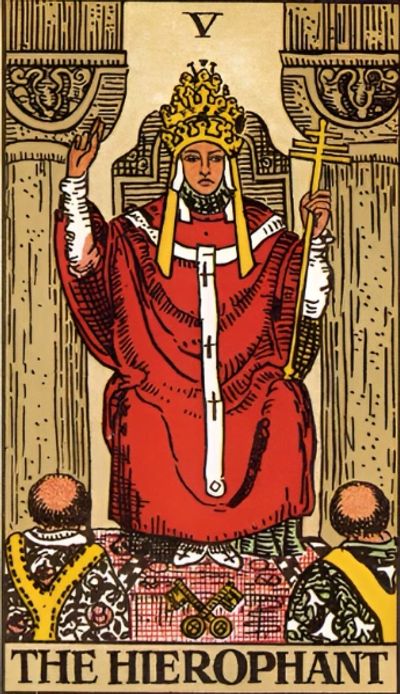
The Tarot card associated with Taurus is the Hierophant.
The Hierophant is the Pope. He is a symbol of spiritual authority, a gatekeeper to divinity, a teacher and symbol of the moral and ethical codes of traditional systems that “must” be followed. As the final authority of all things orthodox, he is meant to serve humanity with, dedication, humility, and care. He is the archetype of the church and orthodoxy.
Through the guidance of the Hierophant, we integrate into the systems of our culture. He represents systems of shared beliefs that we need to follow if we want to navigate society in a traditional way. He can represent guidance in how to navigate the codes and regulations of the many systems that we are a part of as we move through life.
Arthur Edward Waite, the author of the Rider-Waite tarot describes the Hierophant as marriage, alliance, captivity, servitude, mercy, goodness, and inspiration. He holds his right hand up in dedication, with two fingers pointed up, which is a spiritual blessing, a sign of well wishing, and a gesture distinguishing between the transparent and concealed part of doctrine. He wears the three-tiered Papal Tiara, and holds a triple cross staff, both symbolising attunement to higher realms and his authority on the earthly plane. We see also two keys crossed. They symbolise the gateway to the conscious and unconscious minds and, his high authority within the church. At his feet kneel two disciples, open to receiving his doctrine.
The Hierophant and Taurus are similar in that embedded within both of their energetic signatures are core values. Both are invested in traditional values and ways of living, and both work towards manifesting their values through the principles of consistency and stability. In both we see a devotion to building something that will endure and be passed down for the stability of future generations.
Morals
Morals are social norms that support social order. They reflect the ethos and behavioural expectations of a given society. Morals are not static. As they emerge within social structures, they are impacted by and adapt to shifting social conditions. Yet some morals remain steadfast and are foundational in systems and institutions.
They represent shared beliefs, and it is through the understanding of our collective meaning-making that we navigate the maze of society. They are a social compass, orienting an individual within the social systems they inhabit. The morals we believe are our own are heavily shaped by the institutional transmission of social values, and this social process heavily impacts our psychology, reasoning, and personal reflection on our own morality.
In Taurus our values are embodied, and it is in Taurus where we are likely to meet institutional values that are enduring and appear fixed. This is not to say that morals are the domain of Taurus alone. However, it is in Taurus where we clearly see a more static morality, a clear continuity and preservation of sacred tradition, as in Taurus values become stabilised and are carried forward through time. In the Hierophant, the Tarot card associated with Taurus, we encounter a spiritual authority, a gatekeeper to divinity, a teacher of the moral codes embedded within traditional systems. These fixed values are the bedrock of many traditional systems, such as religions, structures of monarchy, and family systems. In Taurus, we tend to see the embodiment of enduring social norms.
For more information on the relationship between values, morals and ethics click the button below:

I Have Therefore I am
As a Venus ruled sign Taurus is pleasure orientated. The love of sex, gratification, and heightened sensual experiences all speak to the desire contained within Taurus' nature. The desire that emerges from the Taurean aspect of the psyche seeks experience and expression through love, beauty, the arts, having, holding, admiration, appreciation, relationships, as well as anything that has been built or crafted that conveys beauty and/or sustainability. The urge to be the object of desire resonates deeply with Taurus and often informs much of what Taurus seeks to achieve early in life.
The urge of Venus is to transcend materialism through love. The urge within Taurus creates a drive in the psyche to build, establish, and accumulate. The Garden of Earthly Delights, c. 1490, by Hieronymus Bosch, is a vivid representation of many of the phases of desire that Taurus can transition through and depicts possible outcomes that the desire of Taurus can lend itself to. There is an innate desire in Taurus to create sustainability, to make manifest the highest of spiritual values. Taurus connects us to the practicality of living and supports laying a foundation of security and stability so that the practical mundane needs of life are met. If we are fortunate enough to have built this foundation in alignment with our values, the spiritual values of Neptune, which is the higher octave of Taurus's ruling planet Venus, are often able to find expression through a natural extension on the foundation we have already built. If we have built our foundation of security out of alignment with our values, we may experience greater hurdles in being at ease with our divinity and allowing the gifts that Venus and Neptune represent within the psyche to flow through us and into our lives.
Taurus offers us the potential for harmony with nature, spirit, and within relationship. It is the dance between desire and values, and the choices made within this courtship of the psyche that determine our ability to receive the gifts that Taurus has to offer. The journey we take through the phases of Taurus flavors our ability to receive love, to rest, to be at ease, and to have a healthy relationship with ourselves, and to what we call ours. This is an important part of the sacred scholarship that Taurus teaches, through the process of, I have therefore I am.
Algol: The Demon Star

Algol is a three star system in the constellation of Perseus, two of which eclipse consistently. This causes the star to have regular dips in brightness as seem from earth and the star appears to be blinking. The star system was named from an abbreviation of its Arabic name, The Demon Head. Algol is the severed head of Medusa. It is associate with trouble, misfortune, rage and obstacles. Algol is pain and injustice that can not be contained. Emotionally raw, there is a transparency and honesty to the explosive response that Algol can evoke.
Whilst Algol is known as the Demon Star, it is said to hold great potential for an individual if the archertype associated with Algol is owned within the psyche and not projected onto others, or othered within the self. If integrated through a spiritual practice it can bestow upon the individual high spiritual rays, that are said to emanate from that system.
The image is is not intended as a precise astronomical star chart, but as a mytho-astronomical visualisation highlighting Algol's traditional placement.
When projected onto the zodiacal ecliptic system, Algol aligns with the zodiac degree of 26° Taurus. The medicine in this zodiacal placement is healing through embodiment. Algol represents our deepest, most unjust wound, where we are tormented by our victimisation.
Its placement in Taurus speaks to a way through the pain. Algol is the trauma that makes embodiment excruciating, where the pain we experience overflows the container. Taurus asks that we transcend what is “ours”. This involves a grief process, and an acceptance of the loss of how we once related to the world. Taurus asks us be open to receiving the sustenance of the natural world. The natural world is a gateway for the heart to feel hope after misfortune, clearing beliefs around victimisation and loss of autonomy, rebalancing the heart chakra, promoting self-love and love of others.
Algol in Taurus is the journey of aligning with our values through love to find peace. It teaches us that healing comes from returning to embodiment, gently, lovingly, with patience and reverence.